
Sodium: The Invisible Power of Neurotron
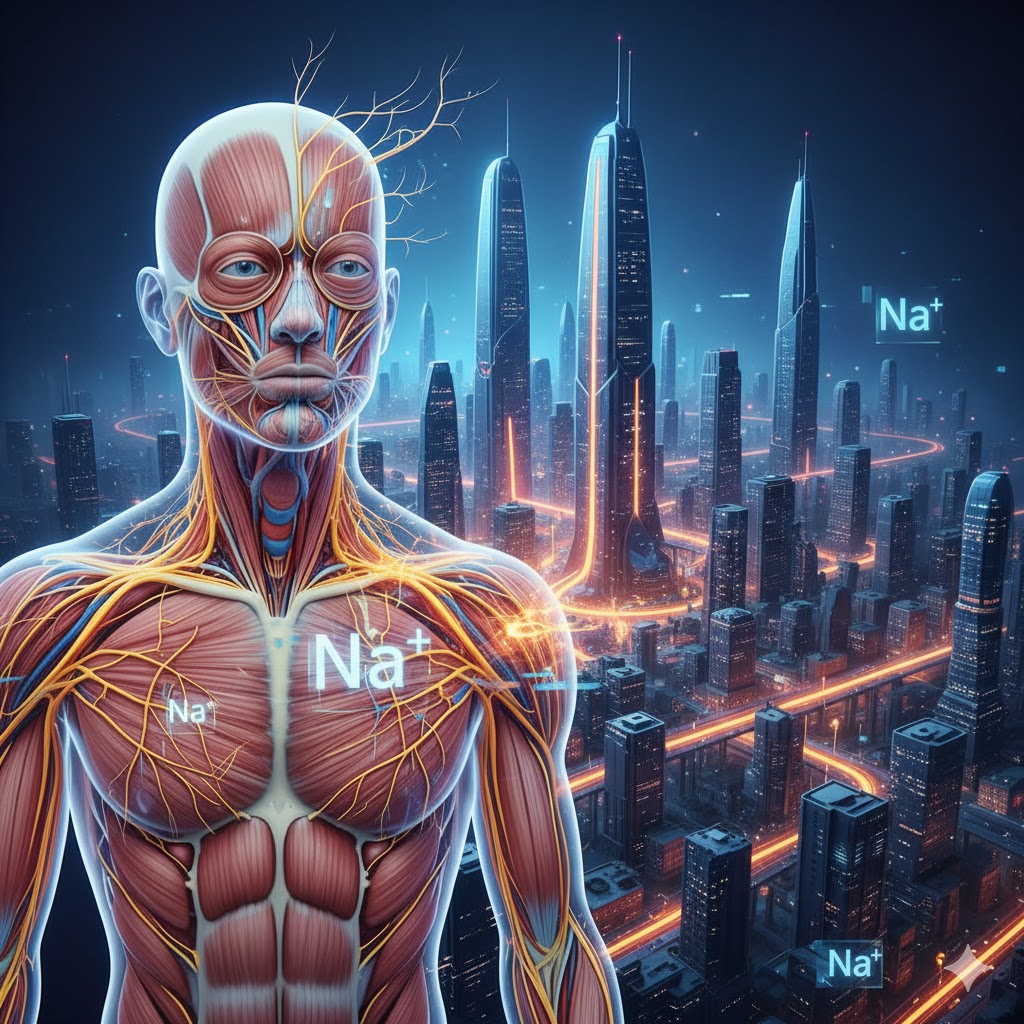
A sci‑fi city, a crashing grid, and one tiny mineral that decides whether everything fires—or fails.
Deep within the futuristic city of Neurotron, power did not just flow through cables and towers. It pulsed through an invisible force called the Sodium Current. This current behaved exactly like sodium inside the human body—controlling nerve impulses, muscle contractions, and the delicate balance of fluids that kept everything alive and responsive.
Every light that flickered on, every hover-tram that glided past, every instant message that flashed across a holo-screen depended on that current. Just as sodium ions rush in and out of nerve cells to transmit signals, Neurotron used controlled sodium flows to keep its systems fast, precise, and beautifully synchronized.
At the centre of this living grid was Dr Elara Voss, a brilliant neuroscientist and guardian of the Sodium Network. From her lab high in the NeuroSync Tower, she watched over the city’s ionic maps—shimmering diagrams of pathways that looked uncannily like human neurons, branching and firing with electric life.
The Day DeHydra Struck
One bright morning, when Neurotron’s sky was painted in soft neon blues, something strange began to unfold. At first, it was a whisper of trouble.
A tram pilot reported sudden lightheadedness. A squad of elite defense soldiers stumbled in training, their usually sharp reflexes dulled. Office workers stared blankly at their displays, struggling to focus on simple tasks. Athletes on the city’s sky-track felt their legs grow heavy, as if gravity had quietly increased.
Within hours, the pattern was undeniable: reaction times slowed, muscles felt weak, and fatigue spread like a shadow across Neurotron.
In the Central Hub, warning icons flashed across the Sodium Grid Map. Parts of the city that normally glowed with bright, steady energy now showed dim and unstable readings. The cause appeared on Elara’s console with a chilling name:
DeHydra – a cyber-virus designed to disrupt sodium balance.
DeHydra didn’t smash systems. It did something far more subtle and dangerous—it disrupted the flow and regulation of sodium, just like dehydration or electrolyte imbalance does in a human body. The city’s neurons-in-steel were experiencing what countless humans feel when sodium and fluids fall too low: dizziness, brain fog, and muscle weakness.
Why Sodium Was the Silent Hero
Elara opened the detailed ion charts. The story was clear. Neurotron was suffering the same way a human does when sodium is out of balance:
Slowed messages
- Without enough sodium, nerve cells can’t fire quickly.
- Thoughts feel slow, reaction time drops, focus fades.
Weakness & cramps
- Muscles need sodium shifts to contract and relax properly.
- Low sodium can lead to heaviness, cramps, or collapse.
Fluid imbalance
- Sodium helps manage where water goes in the body.
- Too little sodium + fluid loss = dizziness and extreme fatigue.
Elara’s Sodium Recovery Broadcast
Neurotron didn’t have time for a full system rebuild. Elara needed a fast, practical solution—one that mirrored how we treat low sodium and dehydration in real bodies.
She opened a global emergency channel. Every screen, visor, and holo-board in the city flickered, then locked onto her message.
Three glowing pillars appeared on screens all over the city—cafés, training grounds, homes, hospitals:
1. Electrolyte Boosters
- Lightly salted broths and soups
- Pickles and olives
- Homemade salty drinks (like nimbu pani with a pinch of salt)
2. Strength Drinks
- Coconut water
- Vegetable or bone broths
- Light salty buttermilk
3. Energy Keepers
- Cheese and yogurt
- Fish and eggs
- Other balanced, mineral-rich meals
The Great Reawakening of Neurotron
As the citizens followed her protocol, the change was almost magical.
Cafés replaced extra coffees with warm broths and electrolyte blends. Training centres handed out salty drinks and recovery snacks. Families prepared simple meals with soups, eggs, and a sensible sprinkle of salt. Bit by bit, the Sodium Current began to stabilise.
The Sodium Grid Map brightened—from dull blue to steady white-gold. Soldiers felt their legs regain strength. Athletes found their sprint again. Thinkers, pilots, and programmers watched their focus sharpen as the brain-fog lifted.
With the city’s ionic balance restored, Neurotron’s firewalls finally cornered DeHydra in the grid, isolating and deleting the virus that had tried to drain their strength from the inside.
Sodium: More Than Just “Salt”
That night, as lights shimmered peacefully across Neurotron, Dr Elara recorded one last message for the city’s memory banks—and for anyone who would listen with their own body in mind.
She encouraged citizens to notice the signs of imbalance in everyday life—dizziness after hard exercise, sudden cramps, intense thirst with weakness, or heavy brain fog when dehydrated. These were not random annoyances; they were messages from their internal Neurotron asking for smarter hydration and electrolyte care.
Was it really just laziness—or was your inner Neurotron asking for better hydration and electrolytes?